
 If you haven’t heard me say it before, let me say it now: Although PPC is cutting edge marketing that is quickly becoming more and more mainstream, its roots lie in one of the oldest forms of marketing: direct marketing. We know this through credit card offers, infomercials, and any other piece of marketing material that passes before you and asks you to “order today”, “apply online”, “operators are standing by, so call now”.
There is a reason why Billy Mays always told you to call now. There is a reason why credit card offers tell you to apply online or call to speak to a representative. These calls to action are best practices, and they hold true with paid search ads that you see on Google, Yahoo and Bing.
It shouldn’t surprise me when search engines use their own direct marketing to achieve goals, but it did surprise me when I opened an envelope that was sent from Google only to see it was an ad for enterprise level Google Apps. It contained a letter explaining the benefits of using Google Apps, and a calculator to show how much you could save a year by switching to Google Apps, based on the number of employees you have. The approach was intriguing, but in all honesty my initial reaction was “What?! Google is sending junk mail?!” Why would a company that makes billions by building a system that allows for ultra-targeting suddenly go to broadcast junk mail from segmented lists?
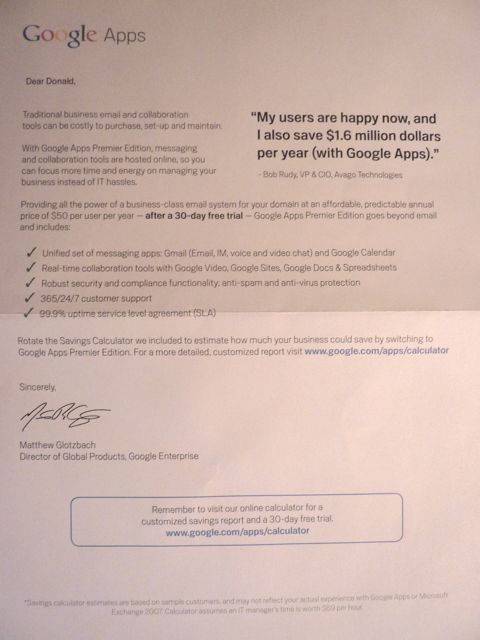
I’m not questioning the marketing prowess of the Google Apps team, in fact I think they probably have excellent reasons for pursuing this tactic. However, I suspect this is an internal beta to see if Google can successfully mine their database of hundreds of millions of people to develop targeted lists for more generalized forms of marketing to feature in AdWords. Consider for a moment the information that Google knows about its users on a query-by-query basis:
- Search History: Google knows what you search for in the past and can combine that history to make assumptions about your hobbies, interests, likes, dislikes, and other personal detail.
- Physical Location: Google knows your physical location by city and/or state based on your IP address (unless you use AOL, who masks everyone behind a single IP address). If you use a Google Lattitude, then Google knows exactly where you are within a couple feet.
- Previous Sales History: If you use Google Wallet and Checkout, then Google knows what you buy and where you buy it from. It also means Google has your credit card number on file, which also means Google has your billing/shipping address. Even if you don’t use Google wallet/checkout, but you do use Gmail, then perhaps your emailed receipts will find their way into your profile with this same information.
The list goes on and on of what Google knows about you when you use their services, but the point is Google can use the information it knows about its users to build some highly targeted and segmented lists that would be of significant benefit to direct mail marketers. It is not too much of an intellectual leap to assume that Google can build a tool in AdWords that advertisers can use that enlists the help of Google Apps and other services to make direct mail creative, and then pay Google to print and ship the direct mail to your chosen segment of recipients, and then use Google Analytics to track the performance of the campaigns. To test this theory, I went to the featured URL and looked at the address bar to see if any Google Analytics tracking was added. Sure enough, the URL auto-filled Google Analytics tracking that looks like this:
utm_medium=dm&utm_source=en-dm-na-us-tco_adw_q110&utm_campaign=us-tco
Let’s break this down piece-by-piece:
- UTM is Urchin Tracking, aka Google Analytics.
- Medium usually refers to the marketing medium, whether it be PPC, display ads, YouTube rollovers, etc. The fact that it equals “DM” (utm_medium=dm) should be easy enough to assume that DM stands for Direct Mail.
- The Source information includes “EN”, which for Google usually means the language abbreviation for English. NA-US probably refers to a North American campaign focused on the United States. As for “adw-q110”, there is no way to be certain, but my assumption is that is internal speak for which list my name came from.
- The campaign is what the Google Analytics user is calling the individual marketing campaign. For example, if Best Buy was having a sale and had 30 display ads all featuring the sale, then those 30 ads would probably have the same campaign tags to monitor performance of the sale.
So let’s assume Google is testing a direct mail campaign that uses their knowledge of people to build mailing lists. How would this be done? How would names and addresses be segmented, categorized, and broken down in a way that adds value to marketers? After all, Google has always targeted people by search query mapped back to bidded keywords in an auction system, which is a lot different than segmentation analysis. So how could they include demographic segments and teach advertisers how to select them? Simple! They would use Facebook as a benchmark.
If you have ever played with a Facebook ad, you know you can target people by gender, age, relationship status, page affiliations, etc. Imagine an Adwords system that does something similar. Google could even add its own twist to the process by requiring advertisers to bid on how much they’re willing to pay on a conversion basis to use the various portions of the list. The more relevant your list is to your target audience, the more you’re willing to pay to speak to those potential customers. The process may look something like this:
- The advertiser logs into Adwords and creates a new campaign called Direct Mail.
- The campaign wizard walks the advertiser through targeting mail recipients based on any demographic information known by Google, possibly including sites visited (i.e. news/blog junkie would go to Huffington Post and/or NYTimes.com, while tech enthusiasts would be on TechCrunch, C|Net, and others)
- The advertiser uploads any graphics or other creative that pertain to the advertiser’s business, and determines their cost per conversion.
- The advertiser is then shown several templates from Google Docs, and the advertiser picks the ideal layout
- AdWords shows several top-performing PPC ads based on click rates. The advertiser writes additional copy based on best performing PPC ads
- Google offers a specialized landing page created by Google’s Page Optimizer for interested parties to visit, and the advertiser customizes it to fit with the rest of her site
- Campaign data is uploaded into Google Analytics
- The advertiser sets postage delivery times and establishes her CPA bid against other advertisers wanting to target a similar audience
- Google’s systems automatically call up names and addresses based on the advertiser’s chosen segments, prints and labels the mail, and delivers to the post office for delivery.
Since the advertiser is only choosing list segments, Google will never actually share the names and addresses of its users with the advertisers, ensuring the privacy barrier is never broken. Performance is tracked via Google Analytics, and assuming the recipient converts into a customer, the name/billing information is absorbed into normal sales activity of the advertiser, making it impossible to know which purchasers reacted to the direct mail campaign via Google.
Now I could be making a big deal out of nothing. After all, this thought process stemmed all from me receiving a single letter in the mail from Google promoting a single product. However, I highly doubt it will be my last.
The point of this article is not to scare you about what Google knows about you or other users. They recognize that people take privacy very seriously, and even created their privacy dashboard. If you’re more interested in the 3rd party review of Google information, SEOMoz has a great resource that walks you through everything that Google can capture about a user, and how it does so.