
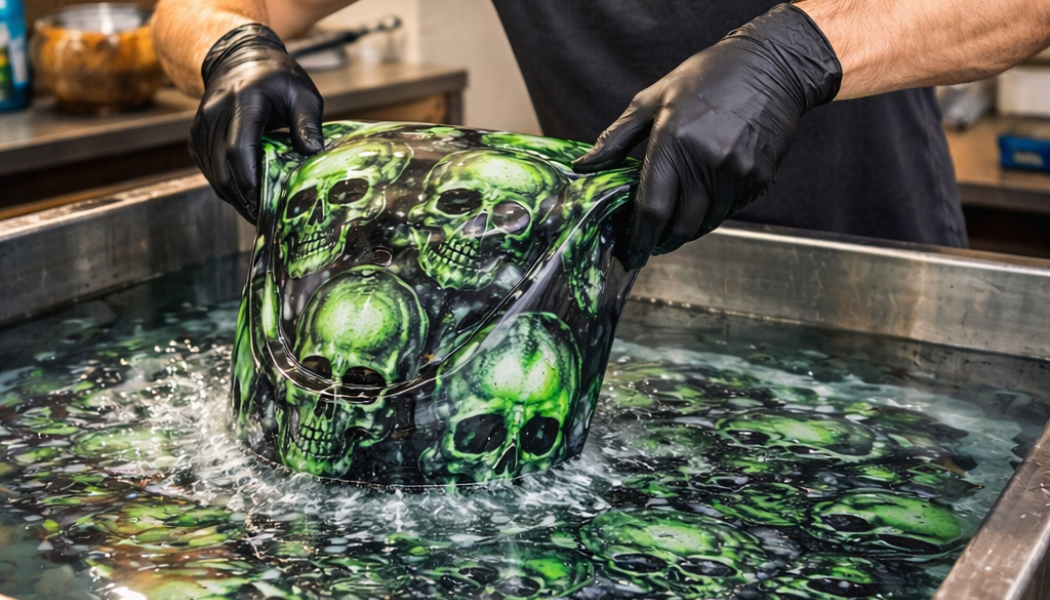
We are living in an economy where attention is the scarcest resource. If you are trying to sell a hobby, a craft, or a side hustle, you aren’t just competing with other products; you are competing with Netflix, TikTok, and the sheer exhaustion of modern life. To cut through the noise, you need something that is visually undeniable. You need something that stops the thumb in mid-scroll. Enter the world of hydrographic dipping.
If you have spent five minutes on social media lately, you have seen it. A pair of plain white sneakers is lowered slowly into a tank of water covered in a floating, colorful film. The tension builds. As the shoe submerges, the pattern wraps around it like magic—carbon fiber, wood grain, or wild graffiti skulls—hugging every curve perfectly.
The problem is that most people think this technology is reserved for massive factories. They don’t realize it is accessible to the average person in their garage. If you are looking to market this hobby—whether you are selling kits, teaching classes, or just trying to build a community—you have to move beyond “it looks cool” and tap into the deeper psychological triggers that make people want to try it.
Here are five marketing angles that position water transfer printing not just as a craft, but as the ultimate creative power move.
1. The Gamer Flex
The gaming industry is massive, and it thrives on customization. Gamers happily drop $20, $50, or $100 on skins for their digital weapons and characters. They care deeply about aesthetics, but often, their physical setup is boring black plastic.
The Angle: “Stop renting your style. Own it.”
Marketing hydro dipping to gamers isn’t about crafting; it’s about modding.
- The Content: Show a side-by-side comparison. On the left, a generic controller that everyone owns. On the right, a controller dipped in a sticker bomb or red carbon pattern.
- The Hook: Position the dip as a status symbol. A custom-painted controller from a boutique shop can cost upwards of $200. A DIY kit costs a fraction of that. You are selling the ability to have “pro-level” gear on a DIY budget.
- The Vibe: Keep the energy high. This isn’t a tutorial; it’s a reveal. Show the finished product next to a high-end PC setup. It bridges the gap between digital customization and physical reality.
2. Trash into Treasure
The flipping community is huge right now. People love the idea of taking something ugly from a thrift store and giving it a second life. But let’s be honest: sanding and hand-painting a complex object takes forever, and if you aren’t an artist, it usually looks like a DIY project.
The Angle: “Factory finish in a home garage.”
Hydro dipping appeals to the flipper because it provides a uniform, professional finish instantly.
- The Content: Find the ugliest, most dated item possible—like a rusty metal ceiling fan blade or a faded plastic dashboard trim piece from a 1998 Honda.
- The Hook: Show the transformation. Sand it, prime it, dip it in a dark walnut wood grain, and clear coat it. Suddenly, that piece of junk looks like high-end mahogany.
- The Vibe: This appeals to the eco-conscious crowd and the side-hustlers. You aren’t just making art; you are adding value. You are saving things from the landfill and making them look expensive.
3. Instant Gratification
Knitting is great, but you have to work for forty hours to get a scarf. Woodworking is impressive, but you need thousands of dollars in saws and planers. Modern hobbyists are often looking for a lower barrier to entry with a high visual payoff.
The Angle: “The ten-second masterpiece.”
- The Content: Lean into the ASMR nature of the process. The sound of the activator spray. The slow dip. The water rushing off the part.
- The Hook: It feels like a magic trick. You prepare the water, lay the film, spray the activator, and boom—the transfer happens in seconds. It triggers that dopamine hit we all crave.
- The Vibe: Market this to the busy professional or the impatient creator. It’s the perfect weekend project because you can start on Saturday morning and have a finished, dry, usable object by Sunday afternoon.
4. Sneakerhead Exclusivity
Sneaker culture is built on one thing: having what nobody else has. People wait in line for hours for limited drops, but what is more limited than a “1 of 1” custom?
The Angle: “Wear art that money can’t buy.”
- The Content: Focus on the accessories. Dipping the hard plastic parts of a shoe (like the heel tab or midsole) or customizing things like Crocs (which are hugely popular for dipping right now).
- The Hook: Exclusivity. You aren’t selling a shoe; you are selling individuality. Tell the story of walking into a room and knowing for a fact that nobody else is wearing your shoes.
- The Vibe: This is pure street style. It’s edgy, it’s risky (dipping an expensive shoe takes guts), and the payoff is massive clout.
5. Business in a Box
Finally, the most powerful marketing angle right now is having a side hustle. People are looking for ways to make extra money. Because hydrographic finishes look industrial and complex, the perceived value is high. People assume a carbon-fiber-look engine cover costs hundreds of dollars to produce.
The Angle: “Turn your tub into a profit center.”
- The Content: Don’t just show the art; show the math. Show a batch of 20 stainless steel tumblers being dipped in an hour.
- The Hook: High margin, low overhead. Unlike laser engraving or 3D printing, you don’t need a $5,000 machine to start. You need a tank, water, film, and practice.
- The Vibe: Empower the reader. Position this not just as a fun way to waste time, but as a legitimate skill trade. There is a demand for custom motorcycle helmets, custom Yeti cups, and custom car parts. Who is going to fill that demand? Why not them?
Shifting Your Perspective
Marketing hydrographic dipping requires a shift in perspective. You aren’t selling a roll of film and a can of activator spray. You are selling the moment of transformation. You are selling the feeling of taking a boring, mass-produced object and dipping it into the water to create something that is uniquely, undeniably yours. Whether you pitch it to the gamer, the hustler, or the artist, the core promise is the same: It looks like magic, but it works like science. And everyone wants to be the magician.